
Key findings at a glance
- Crystalline treatment works inside the concrete, so hydrostatic pressure cannot delaminate it.
- That property is why it is the correct negative-side treatment and a surface coating is not.
- Unreacted chemical stays dormant and re-seals fine cracks that appear years later.
- It needs structural concrete — it does nothing applied over plaster or screed.
- Wide or moving cracks must be injected first; crystalline is not a crack repair.
Basement waterproofing divides on one question: which side of the water pressure are you working on? Get that wrong and the finest coating available will be off the wall within a few seasons. Crystalline chemistry is the answer to the difficult side of that question, and it works on a principle unlike anything else in the trade.
Positive and negative side
Positive-side waterproofing is applied to the face where the water is — the outside of a basement wall, the inside of a water tank. The pressure pushes the system against the structure, which is always the better engineering. It requires either construction-stage access or excavation.
Negative-side waterproofing is applied to the opposite face — the inside of a basement wall, from within the finished building. Here the water pressure acts to push the system away from the wall. That is the mechanism behind the very common failure in which a coating applied inside a leaking basement blisters, bubbles and eventually delaminates in sheets. It is not a workmanship failure. It is physics acting on a system that was never capable of resisting it.
The crystalline mechanism
A crystalline slurry is applied to damp concrete. The active chemicals do not stay at the surface: they diffuse into the capillary network, and there they react with moisture and with the free lime present in all Portland cement concrete. That reaction grows insoluble crystals inside the pores, progressively blocking the routes water would otherwise take.
The consequence is that the waterproofing is not a layer. It is a modified zone within the concrete, typically extending some tens of millimetres in from the treated face. Pressure pushing outward through the wall has nothing to push off, because there is no interface between the waterproofing and the substrate — they are the same material.
| Aspect | Surface coating (negative side) | Crystalline treatment |
|---|---|---|
| Where it sits | A film on the inner face | Inside the concrete capillaries |
| Effect of hydrostatic pressure | Pushes the film off the wall | No interface to delaminate |
| Typical life on the negative side | Months to a few years | Life of the concrete |
| Self-sealing of later fine cracks | No | Yes, up to a few tenths of a mm |
| Works on damp substrate | Generally no | Yes — it needs moisture to react |
| Requires sound structural concrete | Bonds to most substrates | Yes — no effect on plaster or screed |
The fifth row is worth noting because it inverts the usual site rule. Most coatings demand a dry substrate. Crystalline chemistry needs moisture to work, and the surface is deliberately saturated before application. This makes it applicable in situations where nothing else can be applied at all.
Not sure what your property needs?
Book a free deep-scan inspection. We map the moisture, trace where the water actually enters, and give you a written report with a fixed estimate — at no cost and with no obligation.
Self-sealing, and what it does not cover
Not all the chemical reacts at the time of application. A reservoir of unreacted material remains dormant in the concrete, and if a fine crack forms years later and water reaches it, the chemistry reactivates and grows fresh crystals into the crack. In practice this seals hairline cracking up to a few tenths of a millimetre without any intervention, which is a genuinely valuable property in a structure that will never be accessible again.
It does not seal a wide crack, and it does not seal a moving one. Anything beyond hairline must be injected first, and only then treated. A specification that offers crystalline slurry as the answer to a visibly cracked and actively leaking wall has skipped a step.
Two ways it is used
As a surface slurry on existing structures
Applied to the prepared concrete face of an existing basement, tank, lift pit or sump, at roughly 1.0 to 1.5 kg/m² per coat over two coats. The surface is saturated first and damp-cured for 48 to 72 hours afterwards. Letting the surface dry out before the crystals have formed is the most common site failure with these systems and it substantially reduces the result.
As an admixture in new concrete
Dosed into the mix at construction stage, distributing the chemical throughout the section rather than inward from one face. This is the stronger application and should be specified on any new water-retaining or below-grade structure, alongside — never instead of — proper waterstops at the construction joints.
Where it fits in a basement strategy
Crystalline treatment is one element, not a complete answer. On a leaking basement the sequence is usually: inject the active cracks and joints to stop flowing water; apply crystalline treatment across the concrete faces; and wherever it is physically possible, relieve the pressure with a perimeter drain and a working sump. A structure that is not under a permanent head is a far easier structure to keep dry than one relying on any system to hold water back.
Basement leaking and excavation is not an option?
Frequently asked questions
How does crystalline waterproofing work?
Chemicals diffuse into the concrete and react with moisture and free lime to grow insoluble crystals that block the capillary pores from within.
Can it be applied from inside a basement?
Yes — that is its main advantage, because it operates inside the concrete rather than as a film that pressure can push off.
Does it seal cracks?
It self-seals hairline cracks up to a few tenths of a millimetre. Wider or moving cracks must be injected first.
Book your free waterproofing inspection
Leakproofs by Betterwork works across Pune and Pimpri-Chinchwad. An engineer visits at a time that suits you, deep-scans the affected area, and hands you a written report and fixed price. Eligible work carries a 10-year warranty.
Related guides
A 30-Day Monsoon Readiness Plan for Pune and PCMC Commercial Premises
A four-week pre-monsoon plan for offices, warehouses, factories and retail in Pune and PCMC, plus the four failure points behind…
Learn more
9 Renovation Mistakes That Cause Leaks in Pune Homes
The nine ordinary interior renovation decisions that create leaks in Pune flats within a year, and the sequence that avoids…
Learn more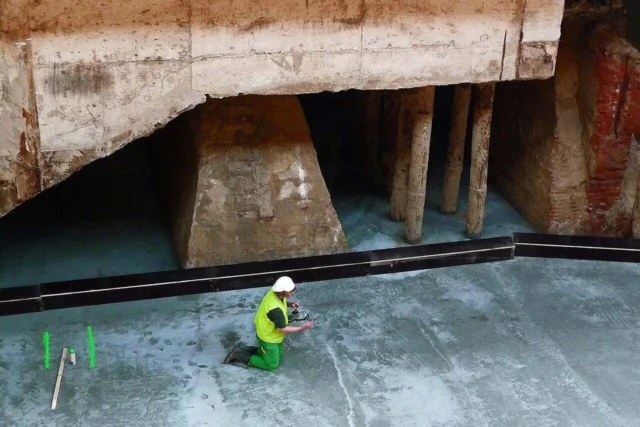
Building a New Home in Pune? The 7 Waterproofing Stages You Cannot Skip
The seven construction stages where waterproofing has to happen in a new Pune home, what to ask for at each,…
Learn moreExplore related services and areas
Our services
- Terrace Waterproofing
- Roof Waterproofing
- Bathroom Waterproofing
- Wall Waterproofing
- Basement Waterproofing
- Water Tank Waterproofing
- Balcony Waterproofing
- Swimming Pool Waterproofing
Specialist treatments
- Terrace Waterproofing
- Bathroom & Toilet Waterproofing
- Basement & Underground Tank Waterproofing
- External & Internal Wall Leakage Treatment
- PU & Epoxy Coating Waterproofing
- Injection Grouting (Pressure / Chemical)
- Dampness & Seepage Treatment
- Monsoon Pre-Inspection & Leakage Detection