
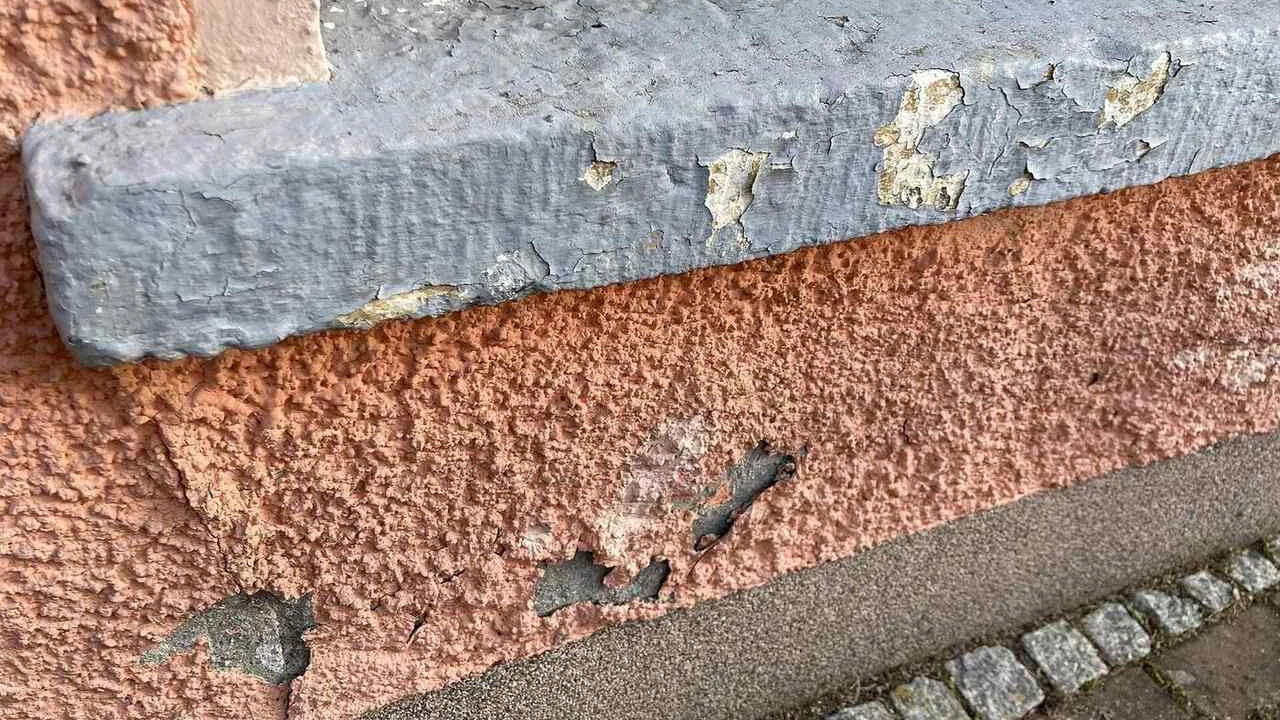
Key findings at a glance
- Efflorescence is a symptom of moisture movement, not a surface contaminant — cleaning it treats the wrong thing.
- Washing it off with water dissolves the salts back into the wall, and they re-emerge within weeks.
- Salts concentrated at the top of a horizontal damp band indicate rising damp specifically.
- Cryptoflorescence — salt crystallising below the surface — physically spalls plaster and brick faces, and is the damaging form.
- A breathable finish is essential; a sealing paint over a salt-loaded wall blisters and pushes the problem higher.
The white bloom on a Pune wall after the monsoon is one of the most frequently misdiagnosed things in building maintenance, mainly because the obvious response — clean it off and repaint — is precisely the wrong one. This explains the mechanism and sets out the sequence that actually resolves it.
What is actually happening
Soluble salts are present in almost every masonry wall from the outset: in the bricks, in the sand, in the cement, in the groundwater, sometimes in the mixing water. On their own they are inert. Introduce moisture and they dissolve. That salt solution then moves through the capillary structure of the wall toward the drying face, and when it reaches the surface the water evaporates and leaves the salt behind as a crystalline deposit.
Three things therefore have to be present simultaneously: soluble salts, moisture, and an evaporation surface. Removing any one stops the process, and the only one you can practically remove is the moisture.
Reading the pattern
| Pattern | Likely moisture source | Where to look |
|---|---|---|
| Horizontal band with salts at its top edge, 600 mm – 1 m up | Rising damp from the plinth | Plinth protection, DPC, adjacent ground level |
| Patches on an external or shared wall, worse after rain | Lateral penetration | Cracks, failed pointing, parapet coping, downpipes |
| Below a window or sill | Sill detail failing | Sill fall, drip groove, frame perimeter seal |
| On a ceiling or the top of a wall in a top-floor flat | Terrace or parapet | Terrace falls, parapet junction, outlet condition |
| On new plaster within months of construction | Construction moisture drying out | Usually self-limiting; do not seal until dry |
| Around a bathroom or kitchen wall | Plumbing leak or wet-area failure | Concealed pipework, sunk slab, tile junctions |
The last row of that table is worth a caution. Efflorescence on newly plastered walls in the first few months after construction is usually construction moisture leaving the wall, is self-limiting, and needs nothing but patience and a breathable finish. Sealing such a wall with an impermeable paint before it has dried is a reliable way to create a long-term problem out of a temporary one.
Not sure what your property needs?
Book a free deep-scan inspection. We map the moisture, trace where the water actually enters, and give you a written report with a fixed estimate — at no cost and with no obligation.
Why washing it off makes it worse
Efflorescent salts are water-soluble — that is how they arrived at the surface. Washing the wall with water dissolves them again and carries a good proportion back into the masonry, where they wait for the next moisture cycle to bring them out. The deposit reappears, often more heavily, and the wall has gained additional moisture in the process. Dry brushing removes the deposit without re-introducing water and is the correct mechanical approach.
The damaging variant: cryptoflorescence
When the evaporation front sits slightly inside the wall rather than at its face — commonly because an impermeable paint or a dense cement render is blocking the surface — the salts crystallise below the surface instead of on it. Crystal growth in a confined pore generates real pressure, and the result is plaster debonding in sheets, or the face of the brick spalling off. This is the mechanism behind a great deal of damage attributed vaguely to “dampness”, and it is caused as often as not by the sealing paint applied to fix the earlier cosmetic problem.
The sequence that works
- Find and cut the moisture source. Use the pattern table above, and if the source is not obvious, get a moisture survey. This step is the whole job; everything after it is finishing.
- Let the wall dry. Roughly a month per 25 mm of wall thickness once the source is cut. This cannot be accelerated meaningfully and should not be short-circuited.
- Remove contaminated plaster. Where salt loading is heavy, hack off to at least 500 mm above the visible damp and beyond the lateral extent of the staining.
- Dry brush and neutralise. Remove residual deposit dry. Where a proprietary salt neutraliser is used, follow the stated dwell time.
- Re-render with a salt-resistant system. A render designed to accommodate salts, rather than a dense cement mix that will simply relocate the evaporation front.
- Anti-salt primer, then a breathable finish. The finish must let vapour out. An impermeable “waterproof” paint at this stage undoes the preceding five steps.
The one-line rule
Treat efflorescence as a message rather than a mess. The salt is telling you where water is moving and where it is evaporating. Follow that information back to the source, cut it, and the deposit stops on its own.
White salt keeps coming back after painting?
Frequently asked questions
What causes white powder on walls?
Soluble salts already in the masonry, dissolved and carried to the surface by moisture, then left behind when the water evaporates.
Is it harmful?
The deposit is cosmetic; what it indicates is not. Sustained moisture causes plaster debonding, paint failure, mould and reinforcement corrosion, and sub-surface crystallisation spalls plaster and brick faces.
How do I remove it permanently?
Remove the moisture, not the salt: cut the source, dry the wall, strip contaminated plaster, dry brush, re-render with a salt-resistant system and finish breathable.
Book your free waterproofing inspection
Leakproofs by Betterwork works across Pune and Pimpri-Chinchwad. An engineer visits at a time that suits you, deep-scans the affected area, and hands you a written report and fixed price. Eligible work carries a 10-year warranty.
Related guides

What Leaks at 5, 15 and 30 Years: A Building Age Timeline for Pune and PCMC
Buildings do not leak randomly. What fails at 5, 15 and 30 years in Pune and PCMC, what is still…
Learn more
Mould and Fungus After the Monsoon: Removing It So It Does Not Return
Why mould returns every Pune monsoon, how to tell condensation growth from leak growth, and the six-step removal sequence that…
Learn more
Ceiling Leak from the Flat Above: Who Pays, and How to Get It Fixed
Water dripping from the flat above? How to trace the real source, what your society bye-laws say about who pays,…
Learn moreExplore related services and areas
Our services
- Terrace Waterproofing
- Roof Waterproofing
- Bathroom Waterproofing
- Wall Waterproofing
- Basement Waterproofing
- Water Tank Waterproofing
- Balcony Waterproofing
- Swimming Pool Waterproofing
Specialist treatments
- Terrace Waterproofing
- Bathroom & Toilet Waterproofing
- Basement & Underground Tank Waterproofing
- External & Internal Wall Leakage Treatment
- PU & Epoxy Coating Waterproofing
- Injection Grouting (Pressure / Chemical)
- Dampness & Seepage Treatment
- Monsoon Pre-Inspection & Leakage Detection